

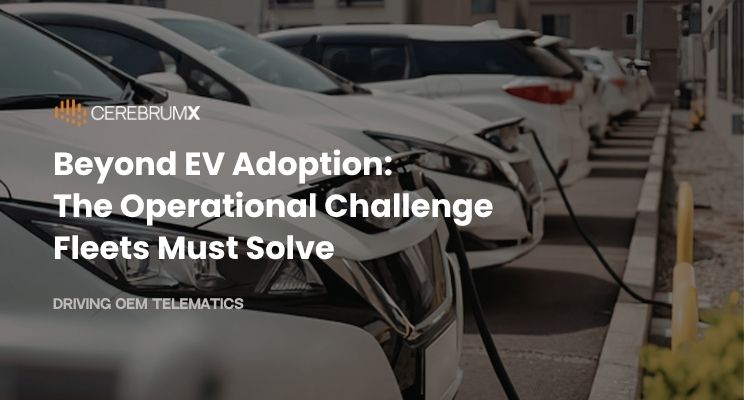
For fleets, the shift to electric vehicles is no longer a question of if, it’s how fast it is. Battery costs are declining, regulations are tightening, and sustainability goals are becoming operational priorities. On the surface, the transition appears straightforward: replace internal combustion fleets with electric vehicles and start realizing long-term savings.
But in practice, electrification introduces a different kind of complexity. The challenge isn’t just adopting EVs. It’s managing them efficiently at scale.
The Hidden Variability in EV Operations
Unlike traditional vehicles, EV performance isn’t fixed. It changes constantly based on real-world conditions. Factors like driving speed, terrain, payload, and temperature can significantly impact range and energy consumption. For a single vehicle, this may be manageable. But across a fleet, operating in different locations and conditions, this variability creates uncertainty.
Routes that appear feasible on paper may not always be reliable in practice. Without clear visibility, fleets risk underutilization, unexpected charging stops, or operational delays.
Charging Isn’t Just an Infrastructure Problem
A common assumption is that once charging infrastructure is in place, the rest falls into line. In reality, charging introduces its own layer of operational complexity. Timing, frequency, and charging behavior directly influence both efficiency and cost. According to the International Energy Agency, unmanaged charging patterns can lead to higher energy costs and reduced operational efficiency. For large fleets, this isn’t a marginal issue, but one that scales quickly. Charging at the wrong time, overcharging, or inconsistent usage patterns can create downtime and cost inefficiencies, which are otherwise avoidable.
Why Embedded Data Becomes Critical
Sourced directly from OEM systems embedded into the vehicle, connected vehicle data provides continuous visibility into parameters like battery state of charge, energy consumption, charging cycles, and vehicle usage patterns. This shifts fleet management from assumption-based planning to data-driven decision-making. Instead of estimating range, fleets can track it in real time. Instead of reacting to charging needs, they can anticipate and optimize them.
From Range Anxiety to Operational Clarity
With real-time insights, fleets can:
- Accurately plan routes based on actual battery performance
- Optimize charging schedules to reduce downtime and energy costs
- Monitor battery health to prevent long-term degradation
- Identify inefficiencies across vehicles and locations
This transforms EV operations from uncertain to predictable. What was previously a limitation—range variability—becomes manageable with the right level of visibility.
Scaling Electrification with Confidence
For smaller deployments, EV adoption can be managed with basic planning. But at scale, across multiple vehicles, routes, and locations, visibility becomes the difference between efficiency and disruption. Embedded data provides a consistent, reliable view across the entire fleet, ensuring that decisions are based on actual vehicle performance and not assumptions.
Beyond Adoption: Making EV Fleets Work
Electrification is often seen as a vehicle transition. In reality, it’s an operational shift. The success of that shift depends on how well fleets can manage variability, optimize charging, and maintain performance over time. Every EV already generates the data needed to do this. The advantage lies in accessing that data directly from the source, and using it to make informed, timely decisions. Because for fleets, the goal isn’t just to switch to electric. It’s to make electrification work at scale.